River Nar, Castle Acre - © J Gladstone


Geo-east Logo


Site search  
 
 
Geodiversity
 
Geology


The rocks of the East of England represent some 170 million years of Earth history. The oldest rocks date back to the Jurassic period, although much older rocks are present at depth, and examples of other ancient rocks have been transported to the region during the Ice Age.

The region's geology may be divided into bedrock (sometimes called the 'solid' geology), and superficial (sometimes known as 'drift'), which includes sediments laid down over the last two million years. The structure of the region’s bedrock geology is relatively simple: the rocks become younger eastwards, and dip gently towards the North Sea basin. By contrast, the superficial geology is notoriously complex, and continues to excite lively discussion among geologists.

Click on the maps below to view more detail.

Bedrock geology of the region. Geological Mapping derived from DiGMapGB-50. British Geological Survey © NERC 2009. IPR/118-45C   Superficial geology of the region. Geological Mapping derived from DiGMapGB-50. British Geological Survey © NERC 2009. IPR/118-45C
Bedrock geology map 0.5 mb PDF   Superficial geology map 0.5 mb PDF

Click on table below to view the simplified geological sequence.
Simplified geological sequence. Photo © Geo-East

Introducing the geology of the East of England

The sediments and fossils of the East of England provide a physical archive of information about environmental change over deep time. They are particularly important for telling the story of the last 3.5 million years, including changes in wildlife and human occupation.

Jurassic

  • The oldest rocks in the region are part of the belt of Jurassic limestone which stretches from Dorset to Yorkshire. They include oolitic limestones and clays laid down in warm, shallow tropical seas. The limestones have been used as building stone, as at Barnack near Peterborough.

    Jurassic limestone in Bromham Bridge. Photo © Martin Whiteley
    Jurassic limestone has been used to build Bromham Bridge, Beds.
  • The Oxford Clay underlies many parts of West Cambridgeshire and Bedfordshire, forming an undulating plain. It has been an important source of clay for brick making in the Bedford and Peterborough areas. It is rich in fossil remains, which include ammonites and large marine reptiles such as Plesiosaurus.

    The Oxford Clay at Stewartby. Photo © Beds & Luton Geology Group
    Excavating the Lower Oxford Clay for brick making at Quest Pit, Stewartby, Beds. Pyritic shell beds form orange-brown layers here.
  • The Corallian Beds include a range of marine clays and limestones containing fossil ammonites and bivalves. They outcrop in the St Ives and Ampthill areas, and also in the form of coral-rich rock at Upware.
     
    The Corallian at Upware. Photo © Geo-East
    The Corallian Beds exposed at Dimmock's Cote Quarry, at Upware, Cambs. Grey marls can be seen in the foreground, with brown, coral-rich reef limestones topping the sequence.
  • The Kimmeridge Clay is a blue-grey, shaly clay rich in fossils. It principally outcrops in the eastern part of the Fens as far north of The Wash, where it forms low-lying land bordering and underlying the Fens.
     
    Kimmeridge Clay ammonite. Photo © Mike Hurn
    A polished section of an ammonite from the Kimmeridge Clay at Crimplesham Quarry, Norfolk.

Cretaceous

  • The Lower Cretaceous Sandringham Sands and Dersingham Beds underlie tracts of heathland in West Norfolk, and are an important source of sand for glass making and foundry moulding.
     

    3x2 West Norfolk heathland on Lower Cretaceous sands. Photo © Robin Stevenson
    The escarpment at Dersingham Bog, Norfolk, showing white sands of the Leziate Beds underlying ferruginous sands of the Dersingham Beds.
  • The Lower Greensand forms a ridge in Bedfordshire. It has been quarried for sand around Leighton Buzzard, Woburn and Sandy. The Carstone rock of West Norfolk is of a similar age, and is quarried for building stone.
     

    Woburn Sands at Deepdale. Photo © Beds & Luton Geology Group
    The Woburn Sands Formation of the Lower Greensand is exposed at Deepdale Quarry, Beds. These sandstones were deposited in fairly shallow waters, and show sedimentary structures such as cross-bedding and clay drapes.
  • The Chalk is a white or grey limestone that totals over 400m in thickness. It forms the prominent scarp of the Bedfordshire and Hertfordshire Chilterns, and continues north as rolling uplands in Essex and Cambridgeshire, with more subdued relief in West Suffolk and West Norfolk. It also forms low hills in the Thurrock area of south Essex. Flints originate in it, and were used by early humans for tool making. It has been extensively quarried over the centuries for agricultural and building lime. Today, the Chalk is the region’s most important source of drinking water.
     

    Lower Cretaceous rocks in Hunstanton Cliffs. Photo © Mike Hurn
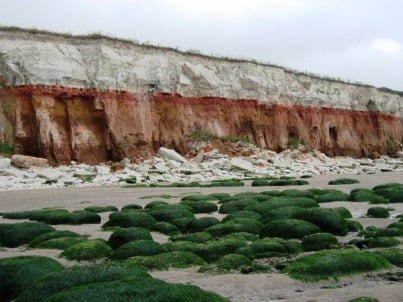
    Lower Cretaceous sediments outcrop in colourful bands in Hunstanton Cliffs, Norfolk. A band of Red Chalk is sandwiched between brown Carstone and white Chalk.

[Page 2] [Back to top]


- Geo-East - East of England Geodeversity Partnership

     
Menu Bottom    

Valid HTML 4.01 Transitional
Copyright © Geo-East Partnership & geo-eat.org.uk geoeast.org.uk
| Site map | Terms of use | Privacy |
Designed and maintained by Surfs Global UK
Copyright © Surfs Global UK International Networks
Valid HTML 4.01 Transitional